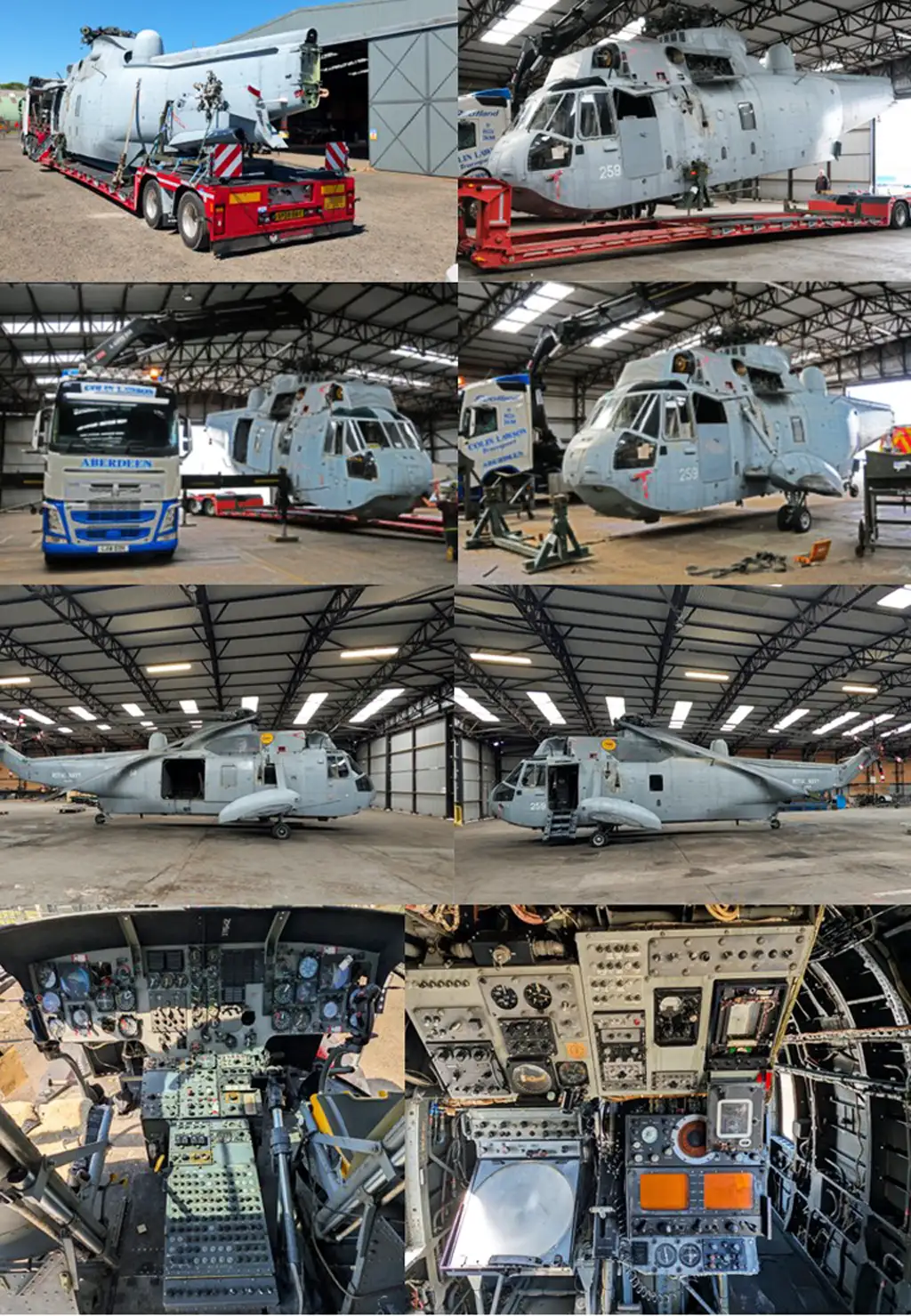
WESTLAND SEA KING HAS.2 XV642 ARRIVES AT MONTROSE
Montrose is proud to receive a new major addition to the museum
The Sea King is in temporary storage and not yet on permanent display
The Sea King was originally designed by Sikorsky in the United States and was built under licence by Westland at Yeovil in Somerset. The British licence-built version differed significantly, with upgraded Rolls-Royce Gnome engines and British-made anti-submarine and computerised flight control systems.
XV642 was the very first Westland-built Sea King helicopter ever produced and took its maiden flight at Yeovil on 7th May 1969. Designated as a Sea King HAS.1 (Helicopter Anti-Submarine Mk 1), it served as the production template and trailblazer for a legendary fleet that dominated British military and maritime search-and-rescue operations for nearly half a century. A total of 344 were built by Westland.
Soon after its first flight, it was showcased internationally, including an appearance at the Le Bourget Paris Air Show in June 1969. It spent its early operational life in flight testing, trials, and evaluation work.
Summer 1969: Delivered to the Royal Navy’s Intensive Flying Trials Unit, 700S Naval Air Squadron (NAS) based at RNAS Culdrose. XV642 spent its early life undergoing rigorous trials to evaluate its advanced anti-submarine systems, computerised flight controls, and shipboard compatibility.
Late 1970s / Early 1980s: Converted and upgraded to HAS.2 / HAS.2A standards, receiving uprated engines and improved acoustics/radar systems to counter evolving Soviet submarine threats. During this phase of frontline operational life, it was designated with the fleet side number 259 (often abbreviated as 59).
XV642 also has the honour of making the first Sea King deck landing when, on 2nd July 1969, it landed on the Royal Fleet Auxiliary Engadine, off Portland.
General Characteristics & Performance
Crew: 4 (2 pilots, 2 observers/sensor operators)
Length: 17.02 m (55 ft 10 in)
Main Rotor Diameter: 18.9 m (62 ft)
Empty Weight: 5,896 kg (13,000 lb)
Max Takeoff Weight: 9,526 kg (21,000 lb)
Powerplant: 2 × Rolls-Royce H.1400 Gnome turboshaft engines.
Max Speed: 138 mph (222 km/h)
Range: Up to 764 miles (1,230 km ) on standard fuel.
Sensors & Avionics
Radar: MEL ARI 5995 search radar (housed in a dorsal radome)
Sonar: Plessey Type 195 dipping sonar.
Flight Control: Advanced Flight Control System (FCS) allowing automatic transitions to a low hover in bad weather.
Armament & Payload
Weapon Stations: 4 external hardpoints (2 each side of the fuselage)
Anti-Submarine Weapons: Capable of carrying torpedoes (e.g., Mk.44 or Mk.46) and depth charges.
Nuclear Capability: Designed with the capacity to carry a WE.177A nuclear depth bomb.